
Waking up to the gentle waves of Lake Victoria brushing the shores of Katanga was the kind of luxury I used to dream about on the coldest winter mornings in my Houston apartment. Opening my eyes at dawn to see the lake waiting for me felt surreal.
A slow day on an island just fifteen minutes from Ggaba.
After my various escapades to cities bordering water bodies, I’ve learned there’s such a thing as lake life—the cousin of beach vibes and island time. What it really means is that time becomes a suggestion. Everything slows. Nothing rushes you. The day unfolds exactly as it wants to.
My mornings begin with writing sessions or with me simply sitting still, staring endlessly at the beauty of Lake Victoria. From where I sit, the shoreline is lined with palms and lush tropical gardens, bougainvillea blooming pink, pomegranate trees heavy with fruit, birds singing as if on cue. Fishing boats drift by, making their final rounds of the morning, gliding gently over calm waves in hopes of one last catch. On the far horizon, the lake melts into the sky until the two become indistinguishable.
The city girl in me, who notoriously hates early mornings has somehow become an early riser here. At 8:37 a.m., I’m the only one awake besides the fishermen. It makes for the most peaceful mornings.
I’ve been offline for over a week. Surprisingly, it hasn’t been difficult at all. The lake slows everything down. Sometimes I just sit and watch it breathe.
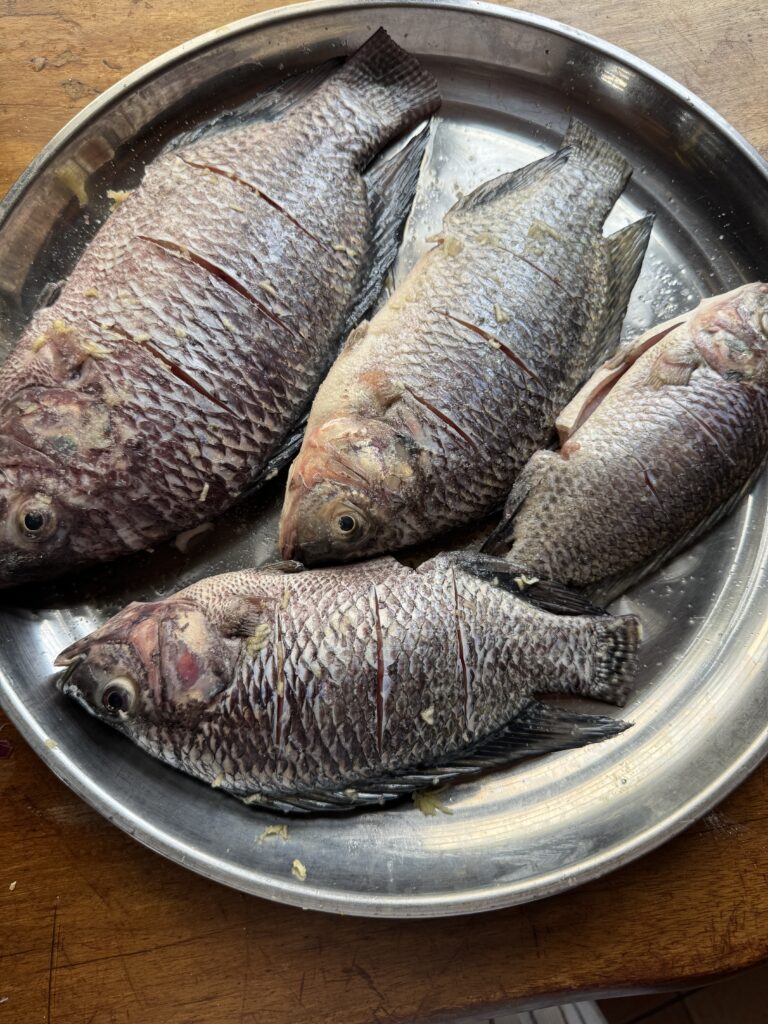
A fisherman brought his catch by for my dad to buy. He stops in every Tuesday, so I spent my afternoon frying fish for the family. Later, we took the speedboat out with floaters and spent the rest of the day drifting on the lake, letting the water hold us. This part of the shoreline remains largely untouched, with dense forests, marshes, papyrus-lined swamps still claiming their space.
Last night around 10 p.m., I sat with my dad, reflecting on how much things change. I told him how millennials were the last generation to truly experience the world before the internet and how I fear this side of the lake may also be living out its final years of quiet tranquility. My dad, who spends a lot of time here, sees it too. Shoreline hotspots are being bought up. New beaches are popping up nearby. A major road is under construction. All signs that the government has its eyes on this island.
Change is coming.
And in all of this, the ones I worry about most are the simple fishing boats drifting past me as I write. Development has a way of excluding locals. It favors tourists, expats, and the wealthy, while the people who grew up on the land are pushed aside, many ending up as hotel staff, others moving away entirely after selling what once belonged to them.
I love what Zanzibar did. They kept their coastal land public. No matter how expensive your hotel is, anyone can walk along your beach. Locals weren’t locked out of their own home.
So later that night, over a shared cup of tea, I told my dad I hoped the stakeholders would think of the locals as plans to transform this place move forward.
But for now, frightening future possibilities aside, I sit quietly with a hot cup of tea, taking in this untouched beauty. Unlike my childhood, which I didn’t realize I was saying goodbye to forever, this time I’m aware. I know these moments may not last a lifetime.
So I’m taking them in slowly.
And I’m capturing them for you, too.